

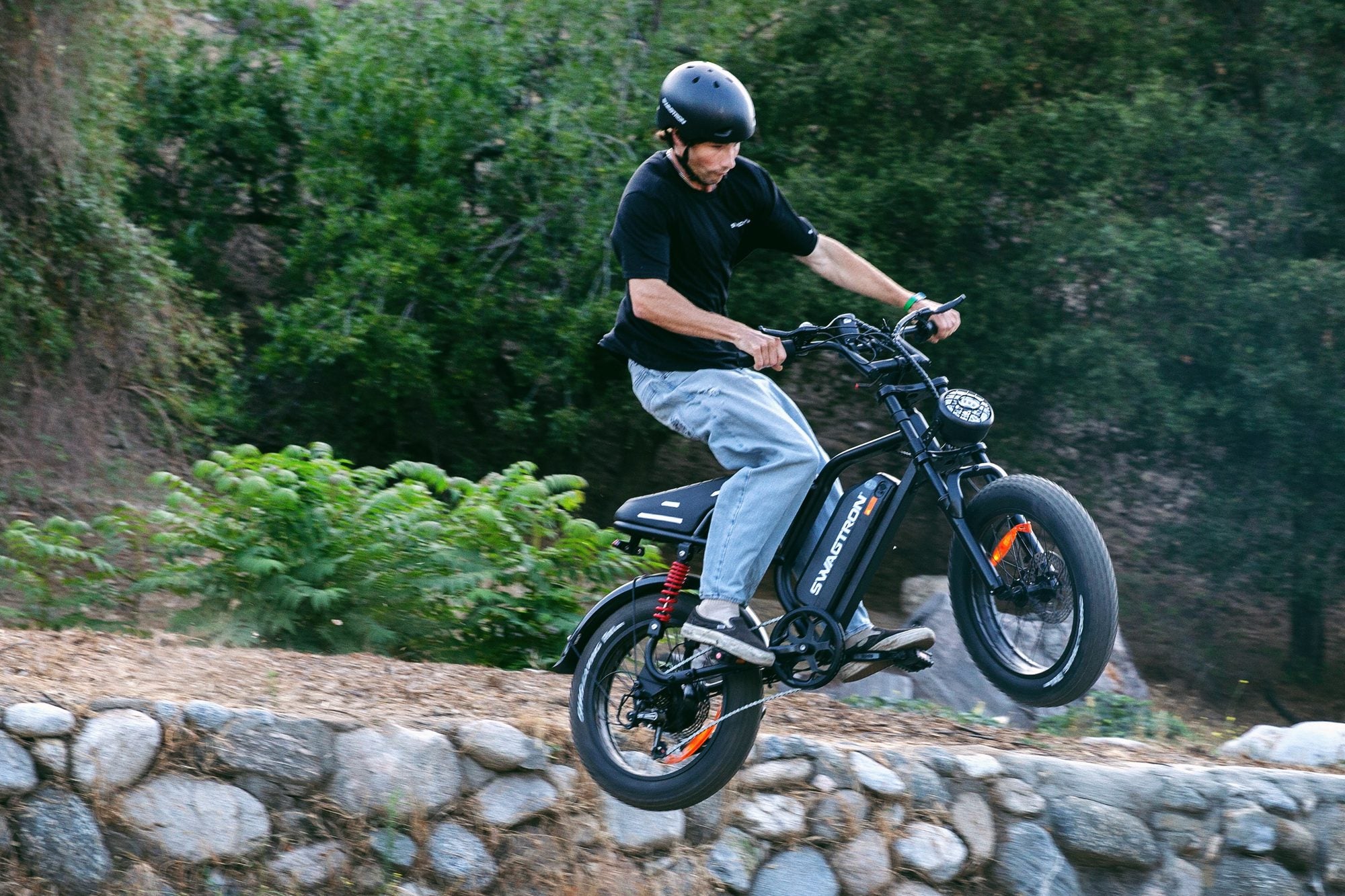
Fat tires are not suspension. Suspension is suspension.
A lot of fat-tire e-bike marketing does the same trick: it shows the four-inch knobby tires in a hero shot and lets you assume the bike can handle anything. The tires absorb the small stuff. The wide footprint floats over loose surfaces. The marketing language gets adventurous.
What the marketing rarely shows is what actually happens when you hit a real pothole, a curb cut, a rail-trail transition, or a stretch of broken pavement at speed. Fat tires give you compliance — they let the wheel follow the ground over small bumps — but they give you no damping. They do not isolate your hands and lower back from sustained vibration. They do not soak up the kind of impact that makes you wince.
For that, you need suspension. And the difference between front fork only, front fork plus single rear shock, and front fork plus dual rear coil-over shocks is the difference most fat-tire e-bike riders feel within their first ten miles.
This article explains what each setup actually does, what it feels like to ride each one over real city surfaces, why most fat-tire e-bikes are hardtails, and how to read a fat-tire e-bike spec sheet for what your body will actually experience under the saddle.
The hardtail problem
Most fat-tire e-bikes on the market are hardtails. That means they have a front suspension fork — usually a spring fork with 60-80mm of travel — and no rear suspension at all. The frame goes straight from the seatpost to the rear wheel, with the wheel rigidly attached to the frame.
A hardtail is mechanically simpler, lighter, cheaper to build, and easier to maintain. Those are real advantages. But on a fat-tire bike intended to handle off-road sections, urban potholes, and the kind of mixed terrain the category implicitly promises, a hardtail forces every impact above the fat-tire compliance threshold straight into the seatpost. From there it goes into the saddle, then into the rider's spine.
Some hardtail brands respond to this by adding a suspension seatpost — a spring or elastomer-damped post that gives 30-40mm of vertical compliance under the saddle. It helps. It does not replace a real rear shock. A suspension seatpost moves the saddle relative to the bike; a rear shock moves the rear wheel relative to the bike. Those are not the same thing. A wheel that can follow the ground keeps the bike in contact with the surface, keeps the brakes effective, keeps the steering predictable. A saddle that bobs above a rigid rear wheel does none of that.
Single shock vs. dual shock: the mechanics
Among fat-tire e-bikes that do offer rear suspension, two architectures dominate.
A single rear shock uses one shock — usually a coil or air spring — between the swingarm and the main frame. It's the standard setup on most full-suspension mountain bikes and on the small handful of full-suspension fat-tire e-bikes. It works. It is also a single point of failure, and it concentrates the suspension load on one component.
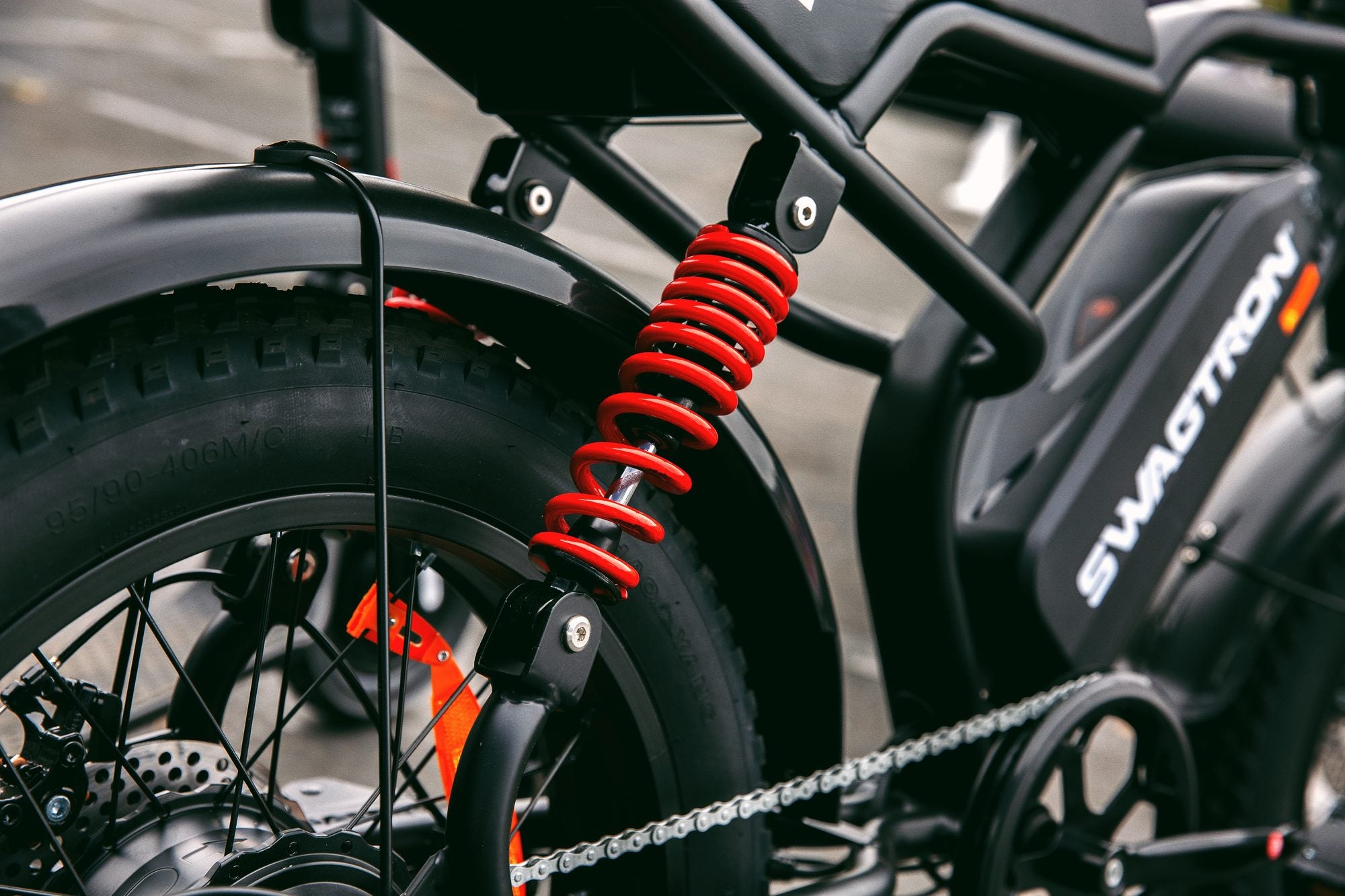
A dual rear shock setup uses two shocks — one on each side of the rear wheel. The most common implementation is dual coil-over shocks running parallel to the seatstays. The load is distributed across two springs and two damping mechanisms, which means each shock works at lower individual stress, lasts longer, and can be tuned to a softer compression curve without bottoming out under hard impacts.
The dual-shock arrangement also pulls visual weight away from the seat tube and into the rear triangle of the frame, which changes the silhouette of the bike — it reads as more capable, more moped-adjacent, less commuter-conventional. That is not just aesthetics; the silhouette signals the engineering.
What you actually feel
A pothole at 20 MPH on a hardtail fat-tire e-bike registers as a sharp impact through the seatpost and into the lower spine. The fat tires absorb the first few millimeters of travel. Beyond that, the rigid rear of the bike has nowhere to go except into the rider. Most riders compensate by lifting their weight off the saddle, which works but is exhausting over a 30-mile ride.
Pothole season is real.
The same pothole on a single-shock bike registers as a thud — a single compression event followed by a slight rebound. The shock absorbs most of the impact; the seatpost flexes a little; the rider stays seated. The ride is noticeably better. On a long ride, the difference accumulates as less fatigue and fewer involuntary winces.
The same pothole on a dual rear coil-over setup registers as a soft compression — two shocks sharing the load, neither one fully extended at the moment of impact, neither one fully compressed at the bottom of the travel. The bike absorbs the impact and returns to ride height in a controlled motion. The rider's lower body stays in contact with the saddle. The handlebars stay where they were. The brakes work consistently because the rear wheel never lost contact with the road.
Over a longer ride — broken pavement, gravel transitions, rail crossings, curb cuts, urban construction zones — the dual-shock setup compounds. Each individual impact is slightly better managed than a single-shock setup would manage it. The result is not a single dramatic difference; it is a thousand small differences that add up to a rider who is less tired, less sore, and more in control of the bike at the end of the ride than at the beginning.
What the active competitive set is actually shipping
Across the active direct-to-consumer fat-tire e-bike landscape at the $1,000-$2,000 price tier, the rear suspension picture looks like this:
| E-Bike | Front | Rear |
|---|---|---|
| SWAGTRON UrbanCruise | Spring fork | Dual coil-over |
| Heybike Mars 2.0 | Spring fork | Single shock + suspension seatpost |
| Aventon Aventure.2 | Spring fork (80mm, lockout) | None (hardtail) |
| Lectric XPeak 2.0 750 | Spring fork | None (hardtail) |
| Mokwheel Basalt 2.0 | Spring fork (lockout) | None (hardtail) |
| Velotric Nomad 2 | Spring fork (80mm, lockout) | None (hardtail) |
| Himiway Zebra (D5) | Spring fork (lockout) | Suspension seatpost only |
| Rad Power RadRunner 3 Plus | Spring fork (Exsho ~65mm) | None (hardtail) |
| Ride1Up Cafe Cruiser | Spring fork (RST) | None (hardtail) |
| Super73 ZX | None (rigid) | None (rigid) |
| Juiced HyperScrambler 2 (brand defunct) | Spring fork | Dual shocks |
Eight of the ten active competitors in our research set are hardtails. One has a single rear shock plus a suspension seatpost. One has neither front nor rear suspension. The only active competitor with a dual rear shock setup at this price tier is no longer in business. UrbanCruise stands alone among active brands with dual rear coil-over rear suspension under $1,500.
Why most fat-tire e-bikes are hardtails
If dual rear coil-over suspension is so much better, why don't more fat-tire e-bikes have it?
The honest answer is engineering and cost. Adding a rear shock requires a more complex frame architecture — a swingarm, pivot bearings, and the structural geometry to mount the shock without compromising frame stiffness. A dual-shock setup adds another layer: two mounting points instead of one, and the frame engineering to handle the load distribution.
That complexity costs money in design, costs money in manufacturing, and adds weight to the bike. For brands optimizing for the lowest possible spec-sheet price, hardtail is the default. For brands designing for actual ride quality on actual city surfaces, the calculation is different — the dual-shock setup pays for itself in rider comfort, in component longevity (the bike's other parts experience less impact stress over time), and in resale value.
The dual rear coil-over at this price tier
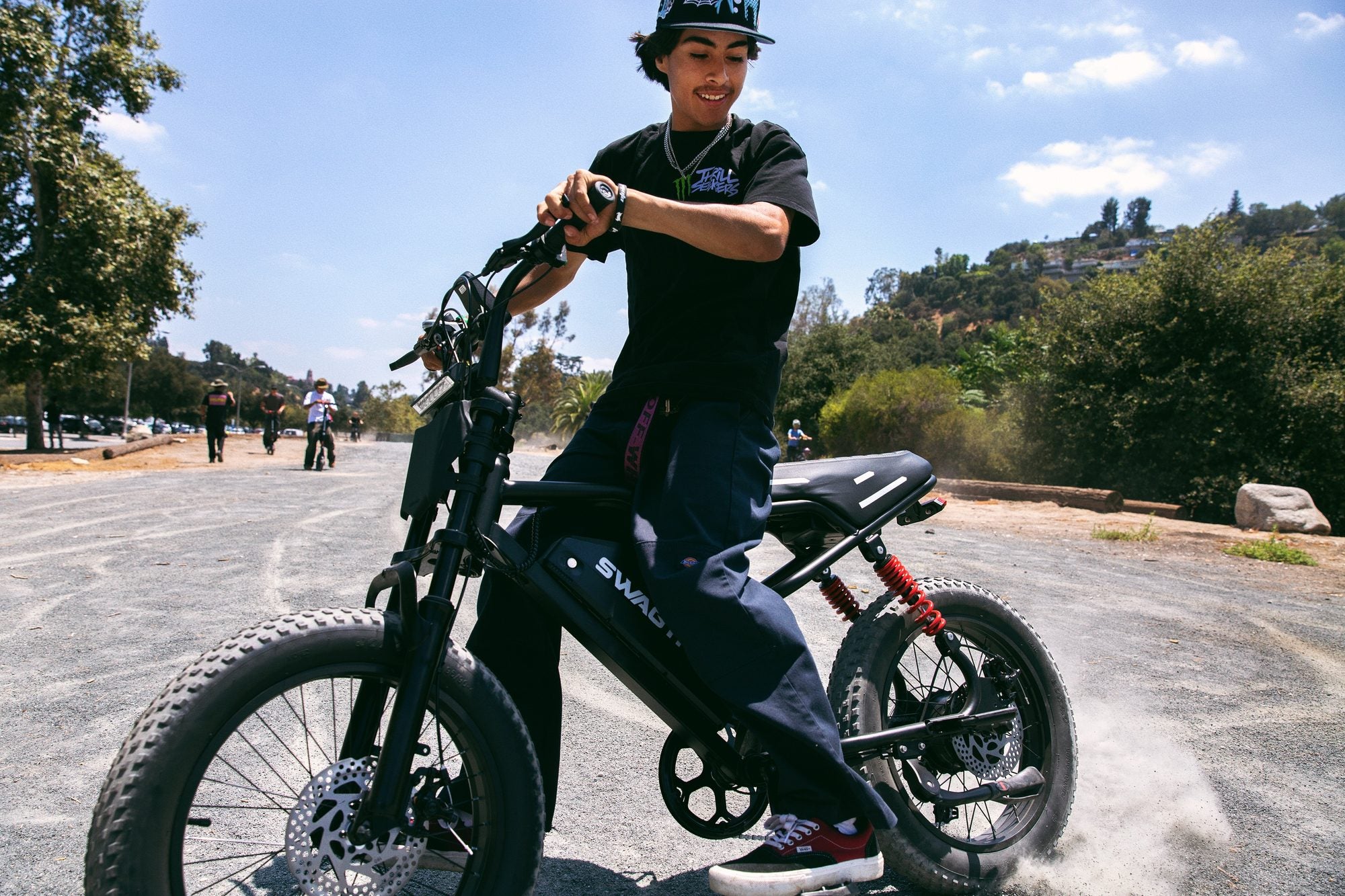
The SWAGTRON UrbanCruise's dual rear shocks are signature red coil-overs. They are functional engineering — distributed load, controlled damping, longer service life — and they are visual identity. The bike's silhouette reads differently from the hardtail competition because of them. The red coils against the matte black frame are intentional brand identity, but they also signal what the bike actually does: it suspends the rear wheel, the way a moped does, the way a small motorcycle does, the way most fat-tire e-bikes at this price do not.
The functional payoff is felt across every ride context the bike is built for: city potholes and curb cuts, fire-road gravel, sand, snow, rail crossings, broken pavement. The bike absorbs impacts the hardtail competition forces into the rider. Over a 60+ mile range, that is the difference between an exciting ride and an exhausting one.
What to ask before you buy
If you are buying a fat-tire e-bike and you intend to ride it on real city surfaces — potholes, curb cuts, gravel, broken pavement, rail crossings, longer rides at speed — these are the suspension questions worth asking the brand before you commit:
- Does the bike have rear suspension? "Suspension seatpost" is not the same answer as "rear shock." Ask specifically about the rear wheel's relationship to the frame.
- If yes, single or dual rear shock? Single is better than none. Dual is better than single, especially under sustained impact loads on a heavier fat-tire bike.
- Coil or air spring? Coil shocks are simpler, more reliable, and easier to maintain at this price tier. Air shocks are lighter and more tunable but require more maintenance.
- What is the front fork travel? 60-80mm is standard for the category. More is not always better; what matters is matched front-rear behavior so the bike doesn't pitch awkwardly under hard braking or impacts.
- Are the shocks user-serviceable, or does the bike need to go to a shop? This matters over the bike's life — and over its resale value.
- Is the suspension setup the same on the step-thru variant? Some brands cut the rear shock on step-thru frames to simplify the geometry. Verify before assuming parity across the model lineup.
The bottom line
Two shocks. One smoother ride.
Fat tires give you compliance, not suspension. For real city riding — potholes, curb cuts, broken pavement, rail crossings, the kind of mixed terrain a fat-tire e-bike implicitly promises — what you actually feel under your seat is a function of the rear suspension architecture, not the tire width.
Most fat-tire e-bikes at this price are hardtails. One competitor has a single rear shock plus a seatpost. One has nothing at all. The SWAGTRON UrbanCruise has dual rear coil-over shocks — the only active brand in our researched competitive set, at this price tier, with that setup. The signature red coils are visual identity and engineering at the same time. They show you what the bike does before you ride it. After ten miles on broken pavement, your lower back will know.
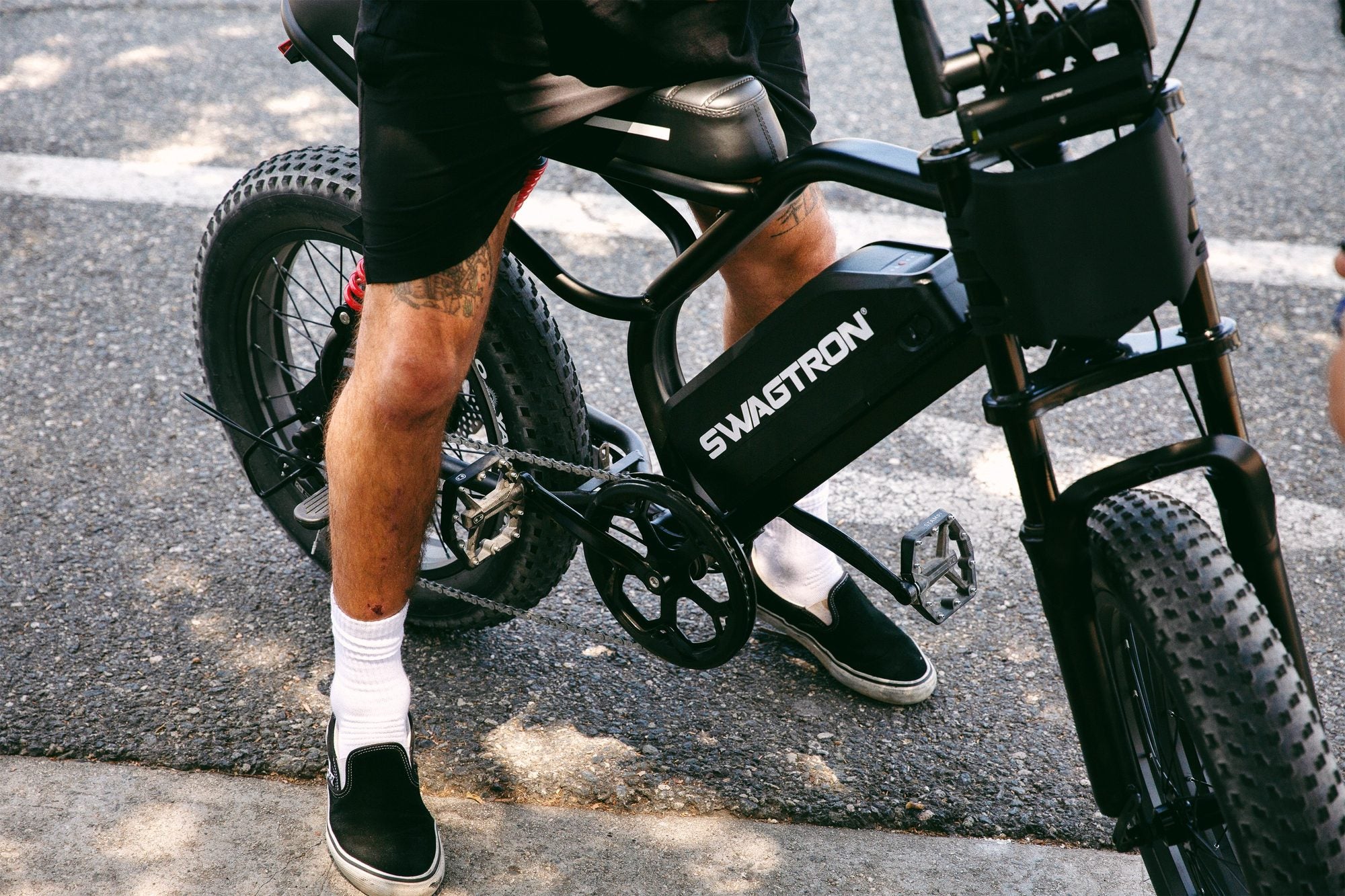
Front fork + dual rear coil-over · 20×4 fat tires · UL ANSI 2849 compliant · 60+ mile range · 62 lbs.
Share:
Range vs. Weight: The Trade-Off Most E-Bike Brands Won't Show You
What UL 2849 Compliance Means for Your Next E-Bike Purchase