

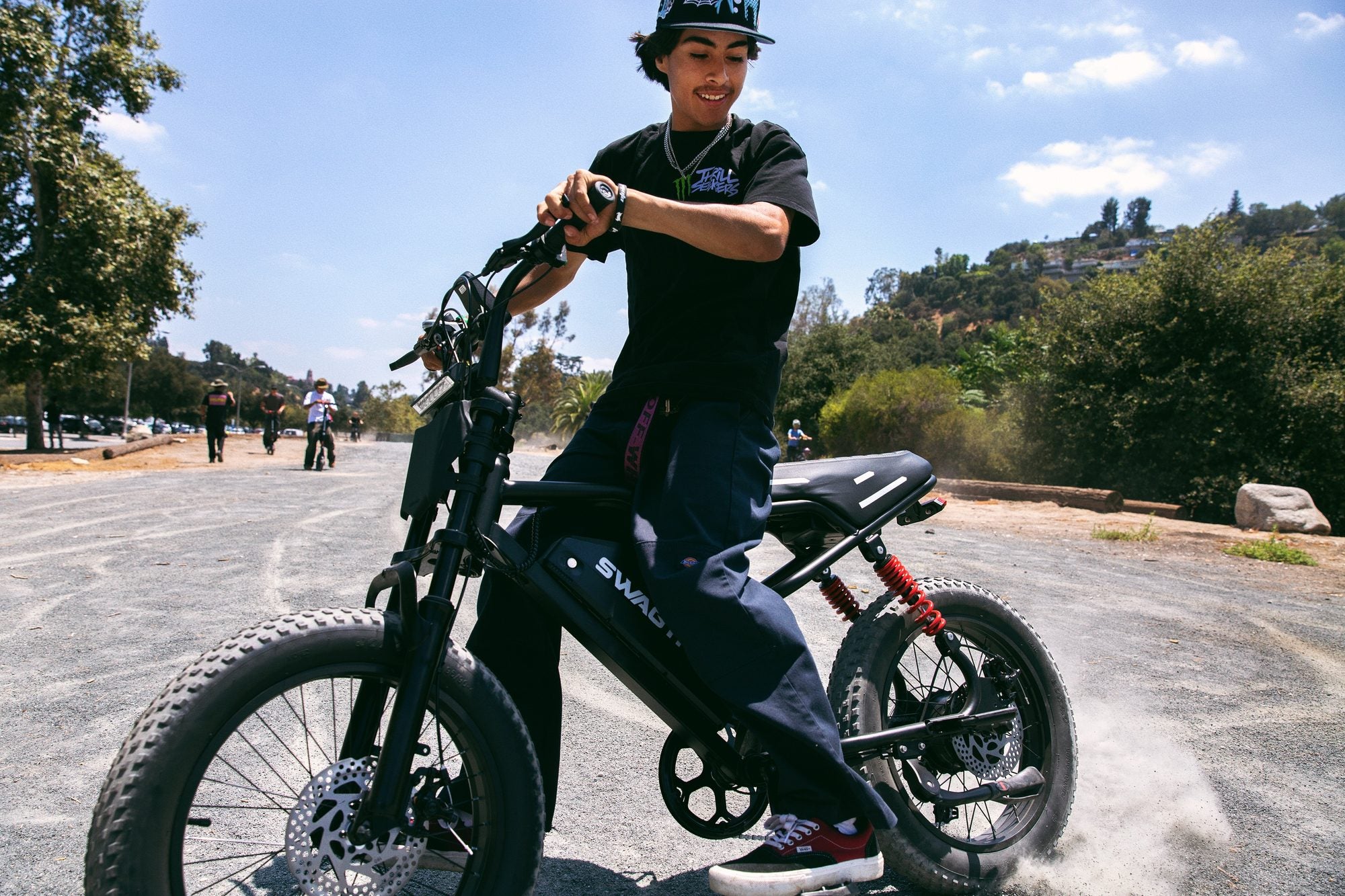
Every range claim has an asterisk. Most asterisks have a footnote you'll never see.
There is one number that determines whether you'll be happy with your e-bike a year after you buy it: how far it actually goes on a charge. Every manufacturer publishes a maximum range claim. Most of those claims are accurate under one specific set of conditions — and meaningless under any other. The real story is e-bike range vs weight: the two numbers brands publish separately because, side by side, they tell on each other.
This article is the math. What determines real-world range, why more range almost always means more weight, how to calculate the range you'll actually get, and how the active fat-tire landscape stacks up on the one number nobody puts in big print: charge per pound of bike weight.
It is more honest than most marketing. It is also more useful before you buy.
The advertised range game
When a brand publishes "70-mile maximum range," what they are publishing is the number their engineering team measured under a controlled test. Those conditions are usually:
- The lowest pedal-assist setting (PAS-1)
- A light rider
- Flat ground, no headwind, no hills
- Mild weather
- A fully charged, never-cycled new battery
- Steady speed, no stops, no traffic
This is the manufacturer's "max range" number. It is not lying — under those conditions, that number is achievable. It is also not the range any actual rider will get on any actual ride, in any actual city, in any actual season.
Real-world range typically lands at 55% to 70% of the advertised max, depending on how you ride, where you ride, and what season it is. A 70-mile claimed bike will commonly deliver something closer to 40–50 real-world miles for a mid-sized rider on PAS-3 in mixed urban conditions.
This is not a complaint about specific brands. The advertised number is the standard the entire industry publishes. What separates brands is whether they'll show you the trade-off behind the claim.
The real math: how to calculate e-bike range
The formula is simple, and it is the same for every e-bike, regardless of brand:
Range (miles) = Battery capacity (Wh) ÷ Consumption rate (Wh/mi)
Battery capacity is the published number — volts × amp-hours. A 48V 15.6Ah battery delivers ≈749 Wh of charge. A 48V 14Ah battery delivers 672 Wh.
Consumption rate is the variable. It depends on:
- Pedal-assist level (PAS). PAS-1 typically consumes 8–12 Wh/mi. PAS-3 typically 18–22 Wh/mi. PAS-5 (full assist) 25–35 Wh/mi. Throttle-heavy riding runs 25–40 Wh/mi.
- Rider weight. Each additional 25 lbs of rider weight increases consumption by roughly 5–8%.
- Terrain. Hills, headwind, and broken pavement all increase consumption.
- Temperature. Lithium-ion batteries lose 20–40% of capacity below 50°F. A bike with a published 70-mile range can lose a meaningful chunk of that in winter.
- Battery age. Lithium-ion cells lose roughly 20% of capacity after 500–800 charge cycles.
Take a representative ride: a mid-sized rider on PAS-3, mixed urban surfaces, mild weather, on a relatively new battery. Consumption sits around 22 Wh/mi. A 749 Wh battery at 22 Wh/mi delivers about 34 real-world miles. That's the number worth planning around. A higher claim is achievable, but only on PAS-1 in conditions most riders are rarely in.
The math is not a secret. It is just rarely surfaced in the same place as the marketing.
The trade-off most brands won't show you
Once you understand the math, the industry trade-off comes into view: more range usually means more battery, which means more weight.
This is the trade-off most fat-tire brands won't surface on a spec sheet, because surfacing it forces them to choose which number to optimize. A brand can build a heavy bike with a big battery and lead with the range claim. Or it can build a light bike with a smaller battery and accept a shorter claim. The result is a market where range claims and weight figures are both technically accurate but rarely shown together.
The single number that captures the trade-off is charge per pound of bike weight — battery capacity in Wh divided by total weight in pounds. Higher is better. It means more usable range for every pound you have to lift, carry, and maneuver.
Specs commoditize. Math doesn't.
Watt-hour per pound across the active set
Here is how the active direct-to-consumer fat-tire landscape stacks up on charge per pound (as of 2026-04-25):
| E-Bike | Charge (Wh) | Weight (lbs) | Wh/lb | Claimed range |
|---|---|---|---|---|
| Himiway Zebra (D5) | 960 | 79 | 12.2 | 80 mi |
| SWAGTRON UrbanCruise | 749 | 62 | 12.1 | 60+ mi |
| Mokwheel Basalt 2.0 | 940 | 80 | 11.8 | 80 mi |
| Ride1Up Cafe Cruiser | 720 | 65 | 11.1 | 50 mi |
| Velotric Nomad 2 | 802 | 76 | 10.6 | 70 mi |
| Aventon Aventure.2 | 720 | 77 | 9.4 | 60 mi |
| Lectric XPeak 2.0 750 | 672 | 73 | 9.2 | 60 mi |
| Rad Power RadRunner 3 Plus | 672 | 76 | 8.8 | 55 mi |
| Heybike Mars 2.0 | 624 | 75 | 8.3 | 70 mi |
| Super73 ZX | 480 | 62 | 7.7 | 35 mi |
Read it honestly. The Himiway Zebra edges the top of the chart at 12.2 Wh/lb — but it does it at 79 pounds. The UrbanCruise sits right behind it at 12.1 Wh/lb, essentially tied for class-best charge-to-weight, and it gets there at 62 pounds — 17 fewer pounds of bike to live with. Super73 ZX matches that 62-pound weight but carries just 480 Wh — UrbanCruise holds over 1.5 times the charge at the same weight.
What the table also shows: the heaviest bikes claim the longest ranges, and the lightest bikes claim the shortest. The trade-off the marketing won't surface is sitting in plain view once the two numbers are placed side by side.
What real-world e-bike range actually looks like
Apply the formula across the same representative ride — PAS-3, mild conditions, mixed urban surfaces, ~22 Wh/mi:
| E-Bike | Charge (Wh) | Real-world range (~22 Wh/mi) | Claimed range |
|---|---|---|---|
| Himiway Zebra (D5) | 960 | ~44 mi | 80 mi |
| Mokwheel Basalt 2.0 | 940 | ~43 mi | 80 mi |
| Velotric Nomad 2 | 802 | ~36 mi | 70 mi |
| SWAGTRON UrbanCruise | 749 | ~34 mi | 60+ mi |
| Ride1Up Cafe Cruiser | 720 | ~33 mi | 50 mi |
| Aventon Aventure.2 | 720 | ~33 mi | 60 mi |
| Lectric XPeak 2.0 750 | 672 | ~31 mi | 60 mi |
| Rad Power RadRunner 3 Plus | 672 | ~31 mi | 55 mi |
| Heybike Mars 2.0 | 624 | ~28 mi | 70 mi |
| Super73 ZX | 480 | ~22 mi | 35 mi |
Here is the honest read. The UrbanCruise is not the longest-range bike in this set. Himiway (~44), Mokwheel (~43), and Velotric (~36) all post more usable miles. But every one of them weighs 76–80 pounds. The bikes that beat the UrbanCruise on range do it by carrying 14–18 more pounds of bike. The proportion of claim-to-real-world is roughly the same across the board — what changes is how much bike you're hauling to get there.
Where the UrbanCruise actually lands
So the honest position is this. The SWAGTRON UrbanCruise is the lightest bike in the active set at 62 pounds, tied with the Super73 ZX. It carries 749 Wh of removable, UL 2271-compliant charge, which works out to 12.1 Wh/lb — essentially tied with the class-best Himiway, but at 17 fewer pounds. It is not the longest-range bike here, and we're not going to tell you it is.
The point is the trade-off itself. Among bikes light enough to actually live with — to lift up a step, carry through a door, hang on a rack — the UrbanCruise gives up the least real-world range to get to that weight. That's the trade most riders are actually making, whether the spec sheet says so or not.
How to calculate before you buy
When you are evaluating an e-bike, the published max range is a starting point, not an endpoint. Here is how to translate it into the number you'll actually plan rides around:
- Find the battery capacity in Wh. If the brand publishes only voltage and amp-hours, multiply them: V × Ah = Wh. A 48V 15.6Ah battery is ≈749 Wh.
- Estimate your consumption rate. PAS-3 mixed urban: 18–22 Wh/mi. PAS-5 hills: 25–35 Wh/mi. Throttle-heavy: 25–40 Wh/mi.
- Divide. Wh ÷ Wh/mi = real-world range. Trim another 10% if you're a heavier rider or expect winter use.
- Compare to the brand's claim. Anything in the 55–70% range of the claim is realistic. Below 50% means the claim was tested under conditions you won't be in.
- Now check the bike weight. A high-range bike at 80 pounds is a different bike from a comparable bike at 62. Divide Wh by bike weight to get charge per pound — that single number reconciles range and livability. The easier-to-live-with bike is the bike that actually gets ridden.
The bottom line
The trade-off most fat-tire brands won't show you is the one they had to make: more range means more battery, which means more weight. The bikes that post the longest real-world range in the table above all weigh 76–80 pounds. The lightest bikes claim the least. Nobody breaks physics.
What you can do is decide which side of the trade you want — and refuse to pay full weight for it. At 62 pounds and 749 Wh, the UrbanCruise lands at 12.1 Wh/lb, essentially tied for the best charge-to-weight in the active set, in the lightest bike on the chart. It is not the longest-range option. It is the one that gives up the least range to stay light enough to live with.
The math doesn't care about marketing. The math just is.
749 Wh removable charge · 12.1 Wh/lb · 62 lbs · 28 MPH Class 3 · dual suspension · 20"×4" fat tires · UL ANSI 2849 compliant (unit) and UL 2271 compliant (battery).
Share:
What UL 2849 Compliance Means for Your Next E-Bike Purchase
Single Shock vs. Dual Shock: What Fat-Tire E-Bike Riders Actually Feel